Composing with students is sometimes a daunting task. I have had the occasional student who will endlessly invent melodies, chord progressions or musical sounds without any issue but for many, creating a musical product for the approval of an adult can be quite an exposing experience. Sometimes a student will have some idea of what kind of sound they want to create but won't know how to achieve it. Sometimes they will claim not to have any ideas at all. In the past I avoided composing with some students because I didn't want to confront these issues. For me, one of the best ways through this has been to embrace plunder.
The basic principle of what I have come to think of as my 'plunder' strategy is to choose a piece the student already likes, work out why they like it, extract those elements that make it appealing and use them in a new composition. This has been an excellent solution to the 'blank page' problem - as much for me as for the student. Rather than having to invent from nothing, we have material to work with. Importantly, it is material I know that they already find pleasing or engaging in some way.
I avoided doing this for a long while. It felt like 'cheating'. If my students were simply taking material from other composers were they really composing? Was I selling them short by denying them the opportunity to invent something of their own? Maybe I was having to resort to this method because I'd failed to give them the internalised repertoire of melodies, rhythms and harmonies they needed to compose 'properly'. These thoughts haven't died completely, but I have been comforted by an experience I had as an undergraduate studying music. Since my late teens I have liked the music of Irish composer Gerald Barry so when the opportunity arose I undertook an analysis of one of his pieces. As I delved into the score I began to realise that almost every bit of musical material in it was stolen. Melodies and rhythms were lifted directly from a hodgepodge of sources - a number of his earlier pieces, an obscure 16th century art song and two Messiaen organ pieces. It seemed almost brazen but it was also hugely liberating as someone who suffered hugely with blank-page syndrome myself. I think ultimately the methods I uncovered in Gerald Barry's piece are just an exaggeration of the truth inherent in all composition - new music is always in some way built on music that already exists. My plunder strategy is for sure not the only way to compose with students and it might not be the best way but I don't think it's illegitimate. And if it's good enough for an established composer who I admire then it's good enough for my students - at least some of the time.
The Chase was based on the piece ‘Jinx’ by Diane Hidy (found in the ABRSM Initial syllabus 2023-24). The mischievous character of this piece is often attractive to young students. Some of this character is attributable to presence of a minor pentascale with the fifth degree flattened (ABCDE♭ and DEFGA♭). This is the material that I first extracted from Jinx for Henry to use in his composition.
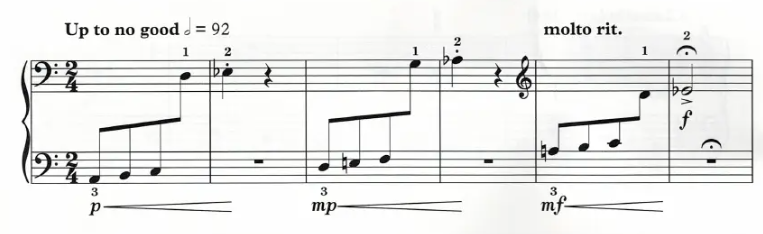
The process was quite informal. I started playing around with the notes, running up and down the five note scale. I didn’t do this for long before Henry began noodling around himself - with much greater verve and urgency than me. Where I was playing with the notes of the scale to try and generate some melodic material, Henry, by playing with increasing velocity, seemed to be establishing a new character for the music. He began to use both hands which helped him to play with even greater speed. I was reminded of the C minor Solfeggietto by C.P.E Bach which harnesses the momentum of a single, racing line of notes shared between both hands.
He arrived at the melodic figure which begins this piece after maybe a minute of experimentation. I don’t remember whether it was me who stopped him when he played this or Henry himself who realised that this idea was a keeper. I pointed out to Henry that in Jinx, this collection of notes also appears starting on D and he came up with the idea of doing A - D - A (higher). I suggested repeating the first A to create a more conventional and predictable design with four phrases which he seemed to prefer. I wonder what the effect on the rest of the composition would have been if I hadn't intervened here. Perhaps it would have been a more interesting piece of music.
For the contrasting section (b.9-12) of The Chase we adapted the chromatically descending thirds from the main melody of Jinx.
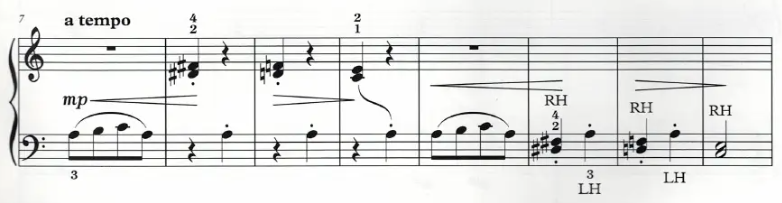
Henry plays his chords with great energy. Where in Jinx they are slightly cheeky, his are dramatic, urgent and full of momentum.
The ‘stabbing’ chords which rise to the top of the piano (b.13-17) were improvised spontaneously by Henry during one lesson. He intuitively understood how to create tension/expectation with the use of the fermata low note. It is interesting to me that he chose to play a C here - possibly because it was easy to find at the bottom of the piano. I could have interrogated this choice to find out which note created the most tension.
It was Henry's idea to repeat the first section but with inverted dynamics. I think it creates a satisfying arc to the whole piece. Many of my students end up composing pieces with simple ternary structures. Maybe this is age and developmentally appropriate but I sometimes wonder if it's due to my caution or laziness as a teacher and composer. Having worked hard to come up with two different types of music, it's sometimes quite easy to conclude that a simple repetition of the first section will do.
Henry came up with a story for this piece. It was based on some playground incident at his school and gave the piece its name. I think it captures the feeling of a ‘Chase’ brilliantly but I don’t and never could remember the details of this story. I didn’t find it nearly as compelling as the musical story this piece tells - I don’t think Henry did either. The issue of extra-musical inspiration in composition would be interesting to discuss elsewhere. But for me, interest in music usually lies in the sound itself rather than the stories and images that surround it.
While reflecting on the process of composing The Chase I was reminded of the famous quote, "Good artists copy, great artists steal". Watching Henry work helped me understand what this might mean. As soon as he was given the "stolen" melodic material from Jinx he began instinctively to play it faster, transforming the material to create a new musical effect, a new feeling. I don't think he once had the impulse to 'imitate' the sound of the original. In fact, I think this would have been a far harder and less intuitive task for Henry. One of my concerns about the 'plunder' strategy was that I was denying my students the chance to be original, that I was restricting their potential creativity. But perhaps Henry shows this concern to be unfounded. Where an adult might feel compelled to imitate, a child is oriented naturally towards transformation. Perhaps 'great' artists are great because they retain their childlike intuition for transformation. If this is true then it's surely worth exploring this capacity in our students while they have it.